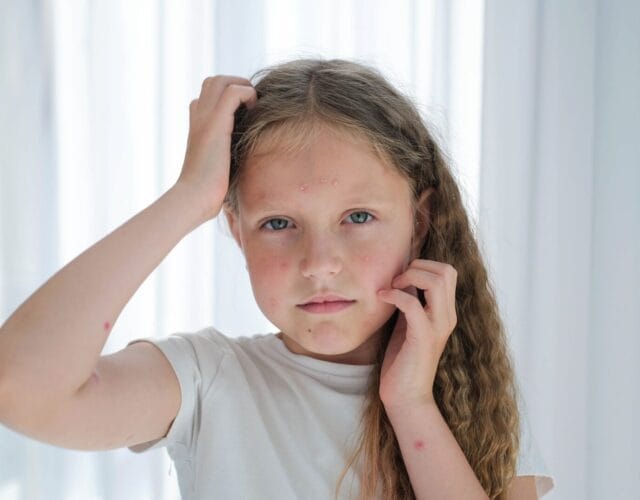
If you search the internet for “eczema,” you’ll mostly see pictures of bright red, inflamed patches on very fair skin. But here is the problem: skin inflammation doesn’t look the same on everyone. In my practice, I see children and adults of all ethnicities, and I’ve seen how easy it is to miss a diagnosis when you’re looking for “redness” on skin that doesn’t turn red.
Understanding what eczema looks like on your specific skin tone is the first step toward finding the root cause and starting the healing process.
Explore Our Eczema Creams Guide To Find The Right Treatment for You
Eczema on Light Skin Tones
On fair or pale skin, eczema follows the “classic” textbook description:
- Color: Patches usually appear bright red or pink.
- Texture: The skin appears dry and scaly, with small, raised bumps.
- After-Effects: Once the flare heals, the skin usually returns to its normal color quickly, though temporary light spots (pityriasis alba) can occur.
Eczema on Medium to Dark Skin Tones (Melanated Skin)
On Brown or Black skin, inflammation behaves differently. Instead of “turning red,” the skin often shifts toward darker pigment:
- Color: Eczema patches often appear dark brown, purple, or ashen gray.
- Texture: It can appear “follicular,” meaning it looks like tiny bumps around the hair follicles, resembling goosebumps that don’t go away.
- Hyperpigmentation: One of the biggest challenges with eczema on darker skin is that inflammation can leave dark marks (post-inflammatory hyperpigmentation) that can last for months after the itch is gone.
- Hypopigmentation: Sometimes, chronic scratching can cause the skin to lose pigment, resulting in light or white patches.
The “Eczema Fingerprints”: Common Features
Regardless of your skin color, eczema usually leaves a few specific “fingerprints”:
1. The “Dennie-Morgan” Fold
Look at the skin under the eyes. People with chronic atopic dermatitis often have an extra crease or fold under the lower eyelid. This is a classic sign of the “Atopic March” (the connection between eczema, asthma, and allergies).
2. Lichenification (The Leathery Look)
When skin is repeatedly scratched over a long period, it thickens to protect itself. It starts to look like leather or the bark of a tree, with very prominent skin lines.
3. Exudate (The Weep)
If the eczema is “active” or infected, you might see clear or yellowish fluid oozing from the skin. When this dries, it creates a honey-colored crust, a major sign that Staph bacteria have joined the party.
Dr. Ana-Maria’s Diagnostic Tip: “Feel, Don’t Just Look”
If you aren’t sure if a patch is eczema because the color is subtle, use your sense of touch. Eczema is almost always rougher than the surrounding skin. It feels like sandpaper or a “dry patch” that no amount of standard lotion can smooth out.
Frequently Asked Questions
Why does my eczema look like “goosebumps”? This is very common in children with darker skin tones. It’s called follicular eczema. It means the inflammation is centered around the hair follicles. It responds beautifully to the same gut-healing and tallow-moisturizing protocols as “flat” eczema.
Will the dark spots go away? Yes! Those dark marks aren’t scars; they are “pigment stains” left by inflammation. Once we heal the gut and stop the “fire” inside, your skin cells will eventually turn over, and your natural tone will return.
Does it look different if it’s infected? Yes. If the area becomes very swollen, feels hot to the touch, or starts oozing yellow fluid, it is likely infected. This is when I recommend antimicrobial support, such as hypochlorous acid or diluted ACV soaks.
Beyond the Surface: Identifying Your Unique Path to Healing
Eczema is a master of disguise. It can be red, purple, brown, or gray; it can be flat and scaly or bumpy and leathery. But no matter what it looks like on the outside, the cause is usually the same: an overreacting immune system. When we identify what it looks like, we can stop guessing and start healing.