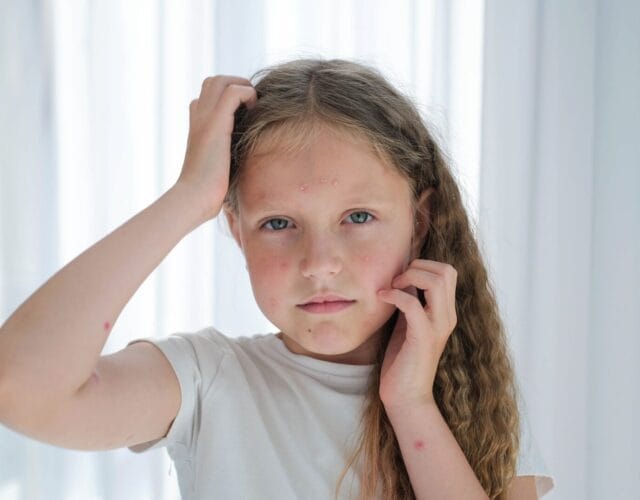
If your child’s eczema is not the occasional dry patch, if it is raw, weeping, bleeding, and covering large areas of their body, you have probably heard some version of “let’s go up on the steroid” more times than you can count. You have also probably wondered, quietly, whether anything will ever actually work.
A new peer-reviewed study, published in Frontiers in Allergy, provides a specific answer for children in exactly this situation. Researchers tracked 197 children in Dr. Ana-Maria Temple’s six-month Eczema Transformation Program, and more than half of them, 102 children, started the program with what is clinically classified as severe eczema.
Here is what happened to that group.
What “Severe” Means in This Study
The study used PO-SCORAD, a validated eczema scoring tool, to measure symptom severity on a 0–103 scale. A score above 50 falls in the severe range. Learn exactly how PO-SCORAD is calculated here.
In this study, 51.8% of participants (102 out of 197 children) started with a PO-SCORAD score above 50. That is a lot of very uncomfortable kids and exhausted parents.
Join the Live Eczema Masterclass
The Result for the Severe Subgroup
Among these 102 children, PO-SCORAD scores dropped by an average of 31.4 points, a 47.2% improvement, from baseline to their final assessment (p < 0.0001).
For context, researchers consider an 8- to 9-point drop in PO-SCORAD to be clinically meaningful. The severe subgroup in this study showed an improvement exceeding that threshold by more than three times.
51.4
Full-cohort baseline average (severe range)
31.4 pts
Average improvement among children who started severe
47.2%
Improvement in the severe subgroup
The study’s authors noted this directly in their discussion: improvements among children with severe baseline symptoms nearly tripled the clinically meaningful improvement threshold. In plain terms, the children who were struggling the most tended to see the most dramatic change.
Why This Matters If You Feel Like You’ve Tried Everything
Parents of children with severe eczema often carry a specific kind of fatigue. You have done the elimination diets, but nobody explained them properly. You have used the steroid, then the stronger steroid. You have washed every sheet in hot water and thrown out every scented candle in the house, and the flare still comes back.
The Eczema Transformation Program does not ask you to guess at one more single fix. It is a structured, six-month, multidisciplinary program delivered entirely online, built on the idea that severe eczema usually has more than one contributing cause and requires more than one intervention addressing it simultaneously.
The program includes:
- A licensed clinical team. Medical doctors, naturopathic doctors, and health coaches guide families throughout.
- Personalized lab work. Depending on a child’s age, labs may include zinc, vitamin D, total IgE, a complete blood count, ferritin, and thyroid markers, reviewed by a clinician early in the program.
- 38 sections of structured content, including 8.5 hours of video, covering nutrition, nutrient repletion, gut health, stress, and environmental triggers.
- Daily support, through live group sessions, one-on-one coaching, and a moderated community forum, so families are not implementing any of this alone.
You can read the full breakdown of the program’s three most actionable pillars, the food swaps, the nutrients, and the environmental changes, in our companion post walking through exactly what families do day to day.
What Happened With Medications
This is a detail worth sitting with if your child is currently on prescription treatment. During the six-month program, 11% of participants discontinued topical corticosteroids and 16% discontinued antihistamines. Among the children who were able to stop topical steroids, PO-SCORAD scores dropped by 39.3 points, a 63.4% improvement, the single largest improvement of any subgroup in the study.
This is not a claim that the program replaces medication, and it is not a suggestion that any family should stop a prescribed treatment on their own.
Important: Do not stop, reduce, or change your child’s medications without guidance from your child’s licensed medical provider. The Eczema Transformation Program is designed to complement, not replace, standard medical care.
What it does suggest is that, for some children with severe symptoms, addressing the contributing lifestyle and environmental factors alongside conventional treatment may reduce how much medication is needed over time, always under a doctor’s supervision.
What This Study Was, and What It Was Not
This was a retrospective observational study, not a randomized controlled trial. Researchers reviewed outcomes data collected from families participating in the program between May 2024 and May 2025. That means the findings show an association between the program and improved severity scores. They do not prove that the program alone caused every improvement, and there was no control group for direct comparison.
The study’s authors are candid about this in their own discussion and call for further prospective, controlled research to confirm these findings. Read the full study limitations and methodology here.
If Your Child’s Eczema Is Severe, Start Here
If you are managing a severe case, the two most useful next steps are understanding what might be driving your child’s specific flare cycle and seeing the framework the study evaluated in more detail.
Take the Free Eczema Quiz to get a sense of the factors most likely contributing to your child’s symptoms, in about two minutes.
Watch the Free Eczema Masterclass, where Dr. Ana-Maria Temple walks through the inside-out framework behind these results.
This information is for educational purposes only and is not medical advice. Always consult your child’s medical team before making changes to medications, supplements, diet, or treatment plans.