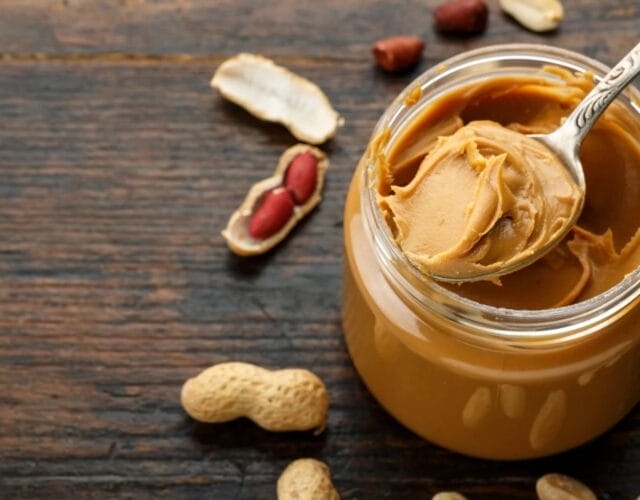
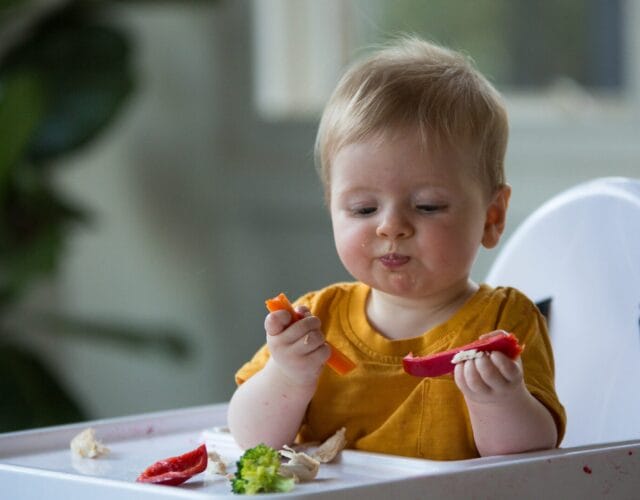
TL;DR: Babies with eczema have a higher risk of developing food allergies. How and when a baby first meets a food matters, so protecting the skin barrier and talking with your pediatrician about early allergen introduction both count. The LEAP study found that early, regular peanut eating was associated with a large reduction in peanut allergy among high-risk infants. Your pediatrician can help you build a plan that fits your baby.
→ Shop Mission MightyMe Nutty Puffs at Target.com
This post is sponsored by Mission MightyMe. As always, I only partner with brands I’d actually put in my own pantry.
If your baby has eczema, there’s something else I want on your radar: food allergies.
I’m Dr. Ana-Maria Temple: a mom, a board-certified pediatrician, author of Ending the Eczema Epidemic, and founder of the Eczema Transformation Program. Before some of those titles, I was a mom of three kids with chronic asthma, eczema, and seasonal allergies so bad that one of them was on five medications at once.
In 2007, I went home from a school nutrition talk and threw out half my pantry while my kids watched in horror. One small swap at a time, they came off their asthma and allergy meds, and the eczema cleared.
So here’s what I tell parents, mom to mom and doctor to parent: eczema is rarely just a skin problem.
In my Eczema Transformation Program, we look at the whole child: nutrition, gut health, stress, and the environment at home, not just the skin. In our 2026 study of 197 children in the program, many with severe eczema, 43% also had allergies, most often to eggs (26%), peanuts (24%), and tree nuts (19%).¹
Eczema travels with food allergies and asthma, which is why food is such a big part of healing. Let’s talk about why, and what you can actually do about it.
Why are eczema and food allergies connected?
Eczema is a chronic skin condition that causes dry, itchy, inflamed skin and a weakened skin barrier, and that weak barrier is a main reason babies with eczema have a higher risk of food allergies. Here’s the number that stops parents in their tracks: about 8% of children overall have a food allergy, but among children with eczema, it’s closer to 30%.²
Babies with eczema have a higher risk of developing food allergies, and the earlier the eczema starts and the longer it lasts, the higher that risk climbs.³ A 2024 study following 6,852 children found that kids who had eczema at any point in childhood had about 3.7 times higher odds of a parent-reported likely food allergy. For babies whose eczema started before 6 months and stuck around, the odds jumped to more than 10 times higher.⁴
Think of healthy skin as a brick wall. In eczema, the mortar is crumbling. Water gets out (hello, dry, itchy skin), and things that should stay out start getting in. That leaky barrier keeps the immune system on high alert, and an immune system on high alert tends to overreact. This is also why eczema, food allergies, and asthma so often show up in the same kid.⁴
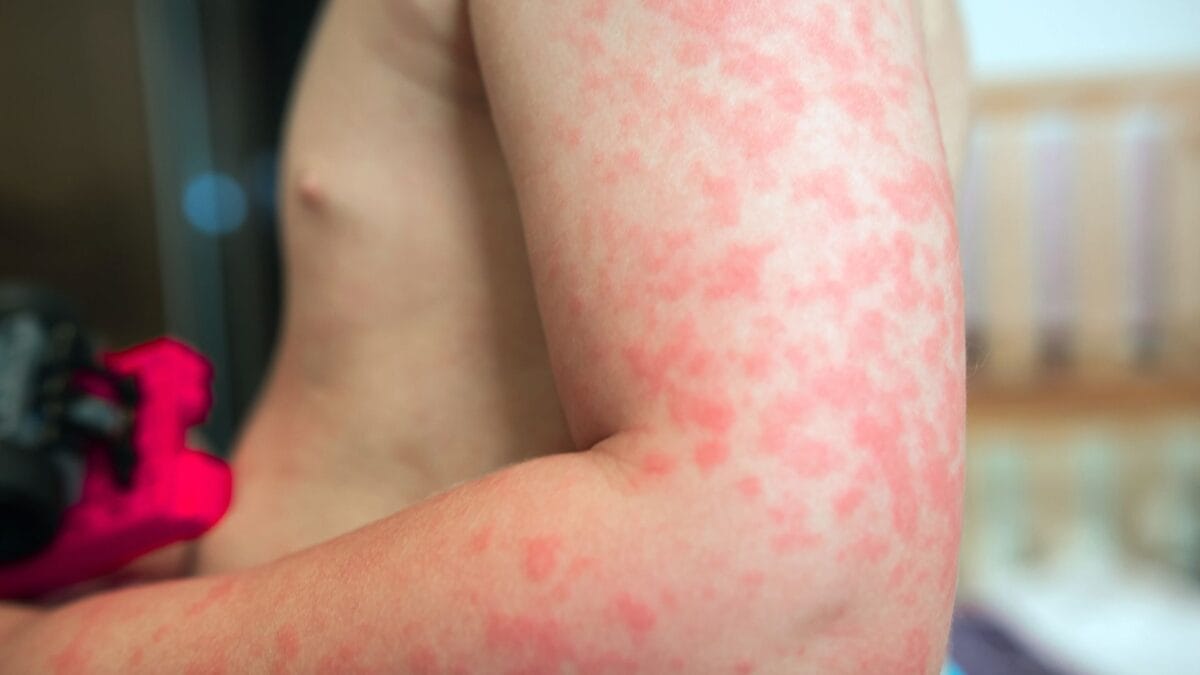
Skin exposure vs. mouth exposure: why the route matters
Sometimes a food protein gets in through broken, inflamed skin by accident: peanut dust on the kitchen counter, a sibling’s PB&J fingers, a hug from Grandpa after his trail mix. When that’s the first introduction, the immune system meets the food while it’s already on high alert, and it can file that food under “threat.” That’s one way an allergy may begin before your baby has ever taken a bite.⁵,⁶
The gut works differently. It’s built to welcome food and teach the body “this is safe to eat.” Eating a food early and regularly reinforces that lesson.⁵
So we want your baby to meet foods by eating them, not for the first time through irritated skin.
That’s why caring for eczema is a two-part job: calm and protect the skin barrier, and talk with your pediatrician about when and how to introduce allergenic foods by mouth. One without the other is like mopping the floor while the sink is still running.
Why the advice changed (and why you’re not crazy)
If you were told to keep peanuts away from your baby or toddler, you’re not imagining things. For years, many of us were taught to delay allergenic foods. From the late 1990s to the early 2010s, food allergies among U.S. children rose about 50%⁷ and peanut allergies roughly tripled.⁸ Many things likely contributed, but the timing led researchers to ask whether avoidance advice was part of the story.
Then the science caught up. Dr. Gideon Lack, a pediatric allergist in London (who later co-founded Mission MightyMe), was lecturing in Tel Aviv when he asked a room of about 200 doctors how many had seen a child with peanut allergy that year. Only two or three hands went up, at a time when peanut allergy was climbing in the UK and US.⁹
The difference? Israeli babies were eating peanut snacks early in their first year, while UK babies were avoiding peanuts, just as guidelines advised. When his team compared about 5,000 Jewish children in each country, peanut allergy was 10 times higher in the UK.¹⁰ Dr. Lack began to suspect that the advice to avoid peanut wasn’t just wrong, but was helping drive the rise in food allergies.⁹
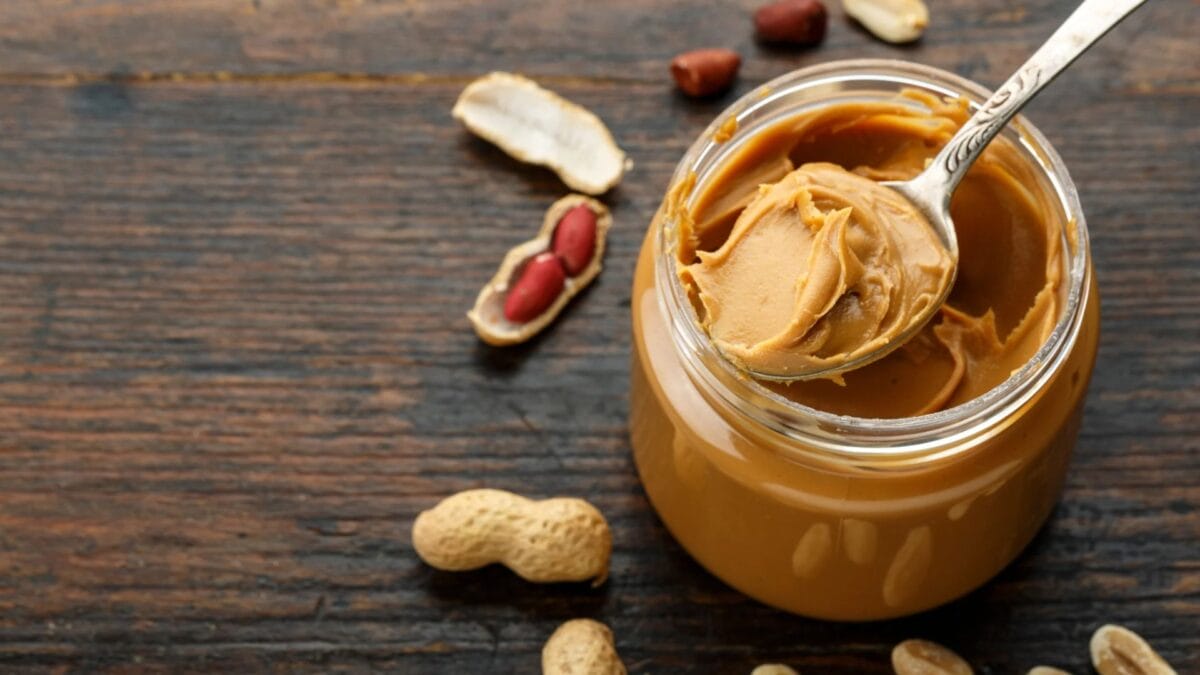
The LEAP Study, in one minute
To test that hunch properly, Dr. Lack and his team at King’s College London launched the LEAP (Learning Early About Peanut Allergy) Study in the mid-2000s, with funding from the U.S. National Institutes of Health. The question was simple: does avoiding peanuts prevent allergy, or does eating it early? They enrolled 640 babies in London, ages 4 to 11 months, all at high risk because of severe eczema and/or egg allergy. Half ate peanut foods regularly; half avoided peanuts completely, until age 5. The results were published in the New England Journal of Medicine in 2015, just over a decade ago.¹¹
The result: early and sustained peanut eating was associated with a reduction in peanut allergy of about 81% overall, and 86% among babies who first tested negative for peanut sensitivity.¹¹ Babies with a large positive skin-prick test at screening were not enrolled, which is why infants with severe eczema or egg allergy are usually evaluated first. Guidelines changed because of this work.¹²
Early is only half the story: keep it in the diet
Here’s the part parents miss most: introducing peanuts once is not the finish line.
In LEAP, the babies kept eating peanuts regularly until age 5.¹¹ The immune system learns by repetition, a bit like toddlers and the word “no.” In LEAP, regular, ongoing eating was part of the plan, and a follow-up study (LEAP-On) found that the protection held even after a year of avoiding peanut at age 5.¹³
So don’t think of allergen introduction as checking food off a list. Once your child has safely tolerated it, the goal is to keep it on the menu, week after week.
Avoid, heal, rebuild: the goal was never a forever-list of “no” foods
Unfortunately, most of the families I work with are past the “prevent” stage. Their child already has eczema and food reactions. Parents often assume the answer is cutting out more and more foods. I get it, and it often does help for a little bit.
Avoiding true triggers is an important part of healing. But in my practice, it’s a season, not a life sentence. The bigger picture looks like this:
- Avoid only the foods that are truly driving reactions, not every food that lights up on a test.
- Heal the skin barrier, calm inflammation, and rebalance the gut microbiome.
- Rebuild tolerance, so nutritious foods can come back to the table.
That last step is where advanced care comes in. That can include carefully managed food reintroduction, always guided by a trained physician. That’s what healing means to me: not a shrinking menu, but an immune system that has learned to tolerate again.
One important note: for a child with an existing food allergy, reintroduction is a medical process, never a DIY snack-aisle experiment. Please don’t hand a peanut product to a peanut-allergic child without your specialist’s plan.
Okay, but how do I actually do this?
A big part of my work is finding families good swaps: snacks and foods with short, clean ingredient lists. It’s the same standard I hold Serawise to: short ingredient list, nothing extra. My rule is less is more. My other rule, as a mom who has eaten lunch standing up or in a car more times than I can count, is that convenience matters too.
(And yes, I see the irony. The doctor who makes nut-free Serawise supplements is writing about peanut puffs. The two go together: we keep allergens out while we heal, and we bring them back in on purpose when the time is right.)
That’s where Mission MightyMe Nutty Puffs come in. Parents know they’re supposed to introduce peanuts and keep serving it. The hard part is doing it often, with variety and finding trustworthy products.
What I like about MightyMe:
- Made with 50%+ real peanuts or mixed nuts, with simple ingredients
- Quick-dissolving, so they work for little eaters
- For starting solids: soften with breast milk, formula, or water, or crumble into purees
- For toddlers: a mess-free snack in a resealable pouch
For families who care about what goes into their kids, it’s an easy fit. And for my eczema families who are further along, once your child’s specialist has cleared peanut and tree nuts, Nutty Puffs can be a simple way to keep those foods in the routine after reintroduction.
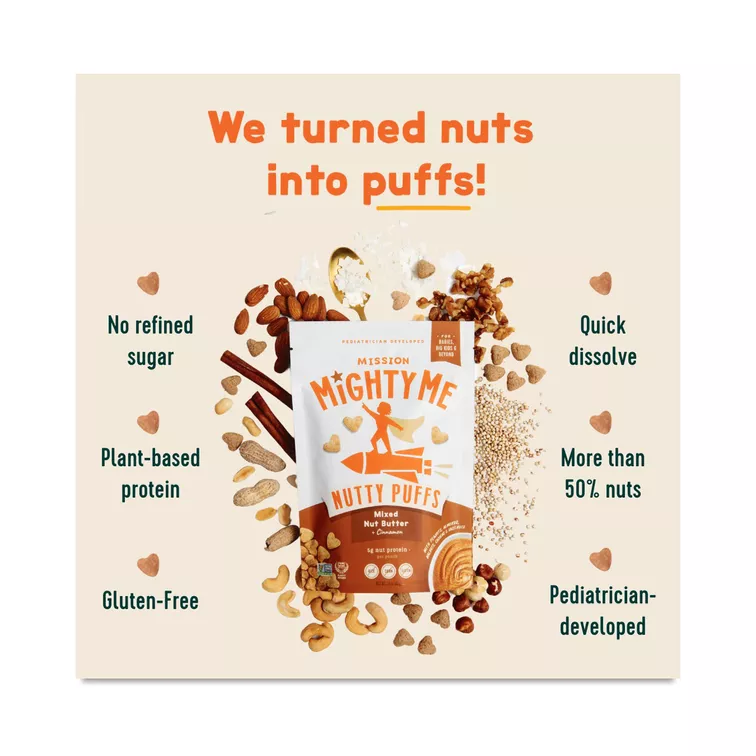
To be clear: Nutty Puffs aren’t a treatment and don’t guarantee your child won’t develop an allergy. The LEAP research is about early and regular peanut eating.¹¹ LEAP studied peanuts, not tree nuts, so ask your pediatrician about tree nut timing too. Mission MightyMe just makes that easier to do.
What I tell parents of babies with eczema
- Treat the skin. A calmer barrier means fewer chances for foods to sneak in the wrong door.
- Talk to your pediatrician early, ideally before or as solids start, about when and how to introduce peanut and other allergens. NIAID’s 2017 guidance roughly breaks down like this: severe eczema or egg allergy, consider peanut at 4 to 6 months after other solids, often with allergy testing first; mild to moderate eczema, around 6 months; no eczema or food allergy, introduce peanut foods freely alongside other solids.¹² Any existing food allergy? Always ask before introducing peanuts.
- Once a food is tolerated, keep it coming. Early, often, ongoing.
- Don’t panic. You didn’t cause this, and you’re not behind. You’re reading a blog about it at 10pm, which tells me you’re a great parent.
Frequently asked questions
When should I introduce peanut to a baby with eczema?
It depends on how severe the eczema is. NIAID guidance says to consider peanuts at 4 to 6 months for infants with severe eczema or egg allergy, often after an evaluation, and around 6 months for mild to moderate eczema. Your pediatrician can help you choose the timing for your baby.¹²
Does early peanut introduction guarantee my baby won’t develop a peanut allergy?
No. In LEAP, early and sustained peanut eating was associated with a large reduction in peanut allergy among high-risk infants, but no food or product can promise prevention.¹¹
Can a child who already has a food allergy use Nutty Puffs?
Not without a plan from your child’s allergist. If your child has a diagnosed food allergy, talk with your specialist before introducing peanut or tree nuts.
Ready to make peanuts and tree nuts part of your little one’s routine?
→ Shop Mission MightyMe Nutty Puffs at Target.com
This post is for education only and isn’t medical advice. Please talk with your child’s doctor about a plan that fits your child.
References
- Temple A-M, Golden D, Temple JD, D’Adamo CR. An online program focusing on modifiable lifestyle and environmental interventions was associated with improved pediatric eczema symptoms: results from a retrospective observational study. Front Allergy. 2026;7:1759379. doi:10.3389/falgy.2026.1759379
- Tompa R. Skin injury may bring on food allergies. Yale School of Medicine. Accessed October 10, 2026. https://medicine.yale.edu/news-article/skin-injury-may-bring-on-food-allergies/
- Tsakok T, Marrs T, Mohsin M, et al. Does atopic dermatitis cause food allergy? A systematic review. J Allergy Clin Immunol. 2016;137(4):1071-1078. doi:10.1016/j.jaci.2015.10.049
- Miltner LA, Vonk JM, van der Velde JL, Sprikkelman AB. Eczema in early childhood increases the risk of allergic multimorbidity. Clin Transl Allergy. 2024;14:e12384. doi:10.1002/clt2.12384
- Lack G. Epidemiologic risks for food allergy. J Allergy Clin Immunol. 2008;121(6):1331-1336. doi:10.1016/j.jaci.2008.04.032
- Brough HA, Liu AH, Sicherer S, et al. Atopic dermatitis increases the effect of exposure to peanut antigen in dust on peanut sensitization and likely peanut allergy. J Allergy Clin Immunol. 2015;135(1):164-170. doi:10.1016/j.jaci.2014.10.007
- Jackson KD, Howie LD, Akinbami LJ. Trends in allergic conditions among children: United States, 1997-2011. NCHS Data Brief. 2013;(121):1-8.
- Sicherer SH, Muñoz-Furlong A, Godbold JH, Sampson HA. US prevalence of self-reported peanut, tree nut, and sesame allergy: 11-year follow-up. J Allergy Clin Immunol. 2010;125(6):1322-1326. doi:10.1016/j.jaci.2010.03.029
- Jaxon C. Dr. Gideon Lack’s lightbulb moment. Mission MightyMe Learning Center. May 8, 2019. Accessed October 10, 2026. https://missionmightyme.com/blogs/learning-center/dr-gideon-lack
- Du Toit G, Katz Y, Sasieni P, et al. Early consumption of peanuts in infancy is associated with a low prevalence of peanut allergy. J Allergy Clin Immunol. 2008;122(5):984-991. doi:10.1016/j.jaci.2008.08.039
- Du Toit G, Roberts G, Sayre PH, et al. Randomized trial of peanut consumption in infants at risk for peanut allergy. N Engl J Med. 2015;372(9):803-813. doi:10.1056/NEJMoa1414850
- Togias A, Cooper SF, Acebal ML, et al. Addendum guidelines for the prevention of peanut allergy in the United States: report of the NIAID-sponsored expert panel. J Allergy Clin Immunol. 2017;139(1):29-44. doi:10.1016/j.jaci.2016.10.010
- Du Toit G, Sayre PH, Roberts G, et al. Effect of avoidance on peanut allergy after early peanut consumption. N Engl J Med. 2016;374(15):1435-1443. doi:10.1056/NEJMoa1514209